
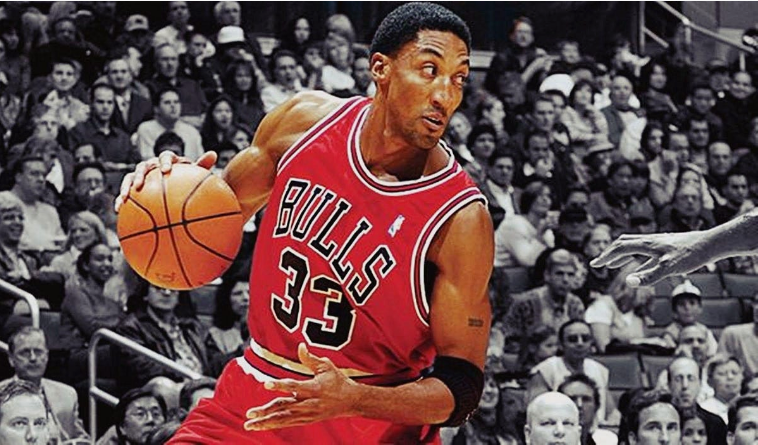
Scottie Pippen Career Stats, Championships & NBA Legacy 2026
Quick Facts: Scottie Pippen
| Category | Details |
|---|---|
| Full Name | Scottie Maurice Pippen |
| Birth Date | September 25, 1965 |
| Birthplace | Hamburg, Arkansas |
| Position | Small Forward / Point Forward |
| Height | 6’7″ (2.01m) |
| NBA Career | 17 seasons (1987-2004) |
| NBA Championships | 6 (1991, 1992, 1993, 1996, 1997, 1998) |
| All-Star Selections | 7 times |
| All-Defensive Team | 10 times (8 First Team) |
| All-NBA First Team | 3 times |
| Olympic Gold Medals | 2 (1992, 1996) |
| Hall of Fame | 2010 |
Scottie Pippen is widely recognized as one of the most complete and undervalued players in NBA history, a six-time champion whose versatility defined the Chicago Bulls dynasty of the 1990s. With 7 All-Star appearances, 10 All-Defensive Team selections, and 3 All-NBA First Team honors, Pippen’s career statistics and impact extend far beyond being Michael Jordan’s sidekick. His ability to score, pass, rebound, and defend at an elite level made him the perfect “point forward” and a critical component of six NBA championships. Despite his Hall of Fame credentials and crucial role in one of basketball’s greatest dynasties, Pippen remains one of the sport’s most underappreciated superstars.
Scottie Pippen Career Statistics: The Complete Numbers
Scottie Pippen’s career statistics reveal a player whose impact transcended traditional scoring metrics. His all-around game made him invaluable across 17 NBA seasons.
Regular Season Career Averages
| Category | Career Average | NBA Rank (Retirement) |
|---|---|---|
| Points Per Game | 16.1 | – |
| Rebounds Per Game | 6.4 | – |
| Assists Per Game | 5.2 | – |
| Steals Per Game | 2.0 | Top 20 all-time |
| Field Goal % | 47.3% | – |
| Games Played | 1,178 | – |
| Total Points | 18,940 | – |
Scottie Pippen Peak Years with Chicago Bulls (1991-1998)
| Season | PPG | RPG | APG | SPG | Achievements |
|---|---|---|---|---|---|
| 1991-92 | 21.0 | 7.7 | 7.0 | 2.1 | NBA Champion |
| 1992-93 | 18.6 | 7.7 | 6.3 | 2.1 | NBA Champion |
| 1993-94 | 22.0 | 8.7 | 5.6 | 2.9 | 3rd in MVP voting |
| 1994-95 | 21.4 | 8.1 | 5.2 | 2.4 | All-Star Game MVP |
| 1995-96 | 19.4 | 6.4 | 5.9 | 1.7 | NBA Champion (72-10 team) |
| 1996-97 | 20.2 | 6.5 | 5.7 | 1.9 | NBA Champion |
| 1997-98 | 19.1 | 5.2 | 5.8 | 1.6 | NBA Champion |
Playoff Performance Statistics
Scottie Pippen elevated his game during playoff competition, consistently delivering when championships were on the line:
| Category | Playoff Average | Notable Performance |
|---|---|---|
| Points Per Game | 17.5 | 21.2 PPG in 1994 playoffs |
| Rebounds Per Game | 7.0 | Strong rebounding for position |
| Assists Per Game | 5.0 | Led 1992 Dream Team in assists |
| Steals Per Game | 2.1 | Elite defensive presence |
| Playoff Games | 208 | Deep playoff runs |
Defensive Excellence: All-Defensive Team Selections
✅ 10× NBA All-Defensive Team (1992-1999, 2000)
✅ 8× All-Defensive First Team
✅ 2× All-Defensive Second Team
✅ Consistently guarded opposing team’s best player
✅ Averaged 2.0 steals per game for career
Scottie Pippen’s Six NBA Championships Explained
Scottie Pippen won six NBA championships with the Chicago Bulls, forming the most dominant dynasty of the 1990s alongside Michael Jordan. His contributions to each championship run were essential, though often overshadowed.
The Championship Timeline
| Season | Finals Opponent | Series Result | Pippen’s Role |
|---|---|---|---|
| 1990-91 | LA Lakers | 4-1 | Defensive stopper on Magic Johnson |
| 1991-92 | Portland Trail Blazers | 4-2 | All-around contributor |
| 1992-93 | Phoenix Suns | 4-2 | Near triple-double averages |
| 1995-96 | Seattle SuperSonics | 4-2 | Key player on 72-10 team |
| 1996-97 | Utah Jazz | 4-2 | Played through injuries |
| 1997-98 | Utah Jazz | 4-2 | Critical despite back injury |
The First Three-Peat (1991-1993)
The Bulls’ first championship run in 1991 marked a breakthrough for both the franchise and Pippen personally. After years of playoff disappointments against the Detroit Pistons, Chicago swept Detroit 4-0 in the 1991 Eastern Conference Finals.
1991 Finals – The Magic Johnson Matchup: In the NBA Finals against the Lakers, Pippen took on the crucial defensive assignment of guarding Magic Johnson. While much focus centered on the Jordan-Magic matchup, it was Pippen’s defensive adjustments that changed the series.
“Phil had in his pocket the strategy that I’ve got Pippen who really plays point guard for us, point forward, runs the offense, and we’ll put him on Magic at some point,” revealing the tactical genius that helped secure the first championship.
Pippen’s defensive impact on Magic Johnson:
- Made Magic work 94 feet
- Used length and athleticism to disrupt passing lanes
- Forced Magic further from the basket
- Created defensive template for series dominance
1992-93 Championship: Against Charles Barkley and the Phoenix Suns, Pippen nearly averaged a triple-double, showcasing his complete game on basketball’s biggest stage. His ability to score, facilitate, and defend made him invaluable.
The Jordan Retirement Season (1993-94)
When Michael Jordan retired in October 1993, Scottie Pippen faced his greatest challenge: leading the Bulls without the greatest player in basketball.
1993-94 Season Leadership Statistics:
- 22.0 points per game (career high)
- 8.7 rebounds per game
- 5.6 assists per game
- 2.9 steals per game (league leader)
- 3rd in NBA MVP voting
- All-Star Game MVP
“This was opportunity with Michael’s departure for me to really step forth and show some leadership,” Pippen explained about his expanded role.
The 1994 Playoff Controversy: Despite Pippen’s stellar regular season, he made a decision that haunted his legacy. In Game 3 of the Eastern Conference Semifinals against the Knicks, with 1.8 seconds remaining, coach Phil Jackson drew up the final play for Toni Kukoč instead of Pippen.
Pippen refused to enter the game, asking out of the play. Kukoč hit the game-winner, but Pippen’s decision created lasting controversy. He later apologized to teammates.
The Second Three-Peat (1996-1998)
The 72-10 Season (1995-96): Jordan’s return brought renewed championship focus. The Bulls assembled the greatest regular season record in NBA history at that time, going 72-10.
Pippen’s contributions to the historic season:
- 19.4 PPG, 6.4 RPG, 5.9 APG
- All-Star selection
- All-Defensive First Team
- Critical two-way player in triangle offense
Playing Through Pain (1997-98): The final championship run saw Pippen battle significant injuries. He underwent ankle surgery late in the offseason, missing the start of the season deliberately.
“I had a ruptured tendon in my ankle and I decided to have surgery late because I was like, you know what, I’m not going to give my summer up trying to rehab for a season,” Pippen revealed about his controversial decision.
In Game 6 of the 1998 Finals, Pippen suffered a back injury early but returned to contribute crucial minutes as Jordan delivered “The Last Shot” against Utah.
What Makes Scottie Pippen Different: The Complete Player
Scottie Pippen redefined the “point forward” position, combining size, skill, and basketball IQ in ways that few players in NBA history have matched.
The Ultimate Two-Way Player
Offensive versatility:
- Could handle point guard duties at 6’7″
- Excellent passer and facilitator
- Developed reliable mid-range and three-point shot
- Effective in transition and half-court sets
- Unselfish team player in triangle offense
Defensive dominance:
- Could guard positions 1-5
- Elite perimeter defender
- Excellent help defender and shot blocker
- Master of reading passing lanes (2.0 career SPG)
- Physical enough to battle power forwards
Pippen vs. Other NBA Legends: Versatility Comparison
| Player | Position Versatility | All-Defensive Teams | Championships | Complete Game |
|---|---|---|---|---|
| Scottie Pippen | 5 positions | 10 | 6 | Elite |
| LeBron James | 4-5 positions | 6 | 4 | Elite |
| Magic Johnson | 3 positions | 0 | 5 | Elite |
| Larry Bird | 2-3 positions | 3 | 3 | Elite |
| Kawhi Leonard | 2-3 positions | 7 | 2 | Elite |
What separated Pippen from peers:
✅ Positional flexibility: Could effectively defend and play all five positions
✅ Unselfish playmaking: Led 1992 Dream Team in assists despite having Magic and Stockton
✅ Defensive excellence: 10 All-Defensive selections shows sustained two-way dominance
✅ Championship DNA: Perfect Finals record (6-0) alongside Jordan
✅ Clutch performances: Delivered in biggest moments despite injuries
“Scotty is such an unselfish player, he’s the greatest all-around player in the NBA right now,” as stated during his prime years, capturing his complete skill set.
The Triangle Offense: Pippen’s Perfect System
Phil Jackson’s implementation of the triangle offense in 1989 transformed Pippen’s career. The system, taught by assistant Tex Winter, emphasized:
- Ball movement over individual dominance
- Player movement and spacing
- Reading defenses and reacting
- Shared offensive responsibility
- Position-less basketball concepts
“The triangle offense changed everything. It emphasized ball movement, spacing, and shared responsibility, giving Pippen more opportunities to handle the ball and make plays,” explaining how the system unlocked his potential.
Pippen’s role in the triangle:
- Primary ball-handler and initiator
- Top of the key facilitator
- Versatile scoring threat
- Defensive anchor allowing Jordan to conserve energy
- Basketball IQ to read defenses and make correct decisions
Scottie Pippen Career Timeline: From Hamburg to the Hall of Fame
Humble Beginnings in Arkansas (1965-1987)
Born September 25, 1965, in Hamburg, Arkansas, Scottie Maurice Pippen was the youngest of 12 children in a tight-knit family. His father, Preston, worked in a paper mill until a stroke left him partially paralyzed, placing financial strain on the family.
High school obscurity: Pippen attended Hamburg High School standing just 6’1″ and weighing approximately 150 pounds. He played point guard but received no college scholarship offers due to his size and lack of exposure.
The walk-on who grew 7 inches: Pippen attended the University of Central Arkansas as a walk-on, initially serving as the team manager. Between his freshman and sophomore years, he experienced a dramatic growth spurt, adding 6-7 inches to reach 6’7″ or 6’8″.
“My high school coach called up his college coach who was coaching the University of Central Arkansas at that time and asked him if he would give me a tryout,” Pippen recalled about his unlikely path.
College transformation: By his junior and senior years, Pippen had developed into a dominant NAIA player, showcasing the versatility that would define his NBA career. He averaged over 20 points and 10 rebounds while displaying guard skills in a forward’s body.
The 1987 NBA Draft: A Franchise-Changing Trade
June 22, 1987: The Seattle SuperSonics selected Scottie Pippen with the 5th overall pick in the NBA Draft. However, within minutes, a trade was announced that would change NBA history.
The Draft Day Trade:
- Seattle sent Pippen to Chicago
- Bulls sent their 1987 and 1989 first-round picks to Seattle
- Bulls also traded Olden Polynice in the deal
The Bulls had identified Pippen as the perfect complement to Michael Jordan, a versatile defender and playmaker who could ease Jordan’s burden.
“I never seen either one of them play but I never seen Charles Oakley play and heard of him either, so you know, you never really can base that on that. I’m anxious to get to camp to see what happens,” Jordan said about the draft picks, not yet realizing what Pippen would become.
Rookie Season and Early Development (1987-1990)
1987-88 Rookie Season: Pippen averaged 7.9 PPG, 3.8 RPG, and 2.1 APG in limited minutes off the bench. His athleticism and defensive potential were evident, but he was raw offensively.
1988 Playoffs breakthrough: In the Eastern Conference Semifinals against Cleveland, Pippen earned his first starting opportunity and delivered 24 points in a crucial game, announcing his arrival.
“Scotty Pippen’s going to be a star in this league, he will be,” the broadcast declared after his breakout performance, recognizing his potential.
Rapid improvement (1988-1990):
- 1988-89: 14.4 PPG, 6.1 RPG, 3.5 APG
- 1989-90: 16.5 PPG, 6.7 RPG, 5.4 APG
- First All-Star selection (1990)
- Established as elite two-way player
The 1992 Dream Team: Basketball Immortality
Scottie Pippen earned selection to the 1992 United States Olympic Basketball Team, widely considered the greatest basketball team ever assembled.
Dream Team roster included:
- Michael Jordan
- Magic Johnson
- Larry Bird
- Charles Barkley
- Patrick Ewing
- David Robinson
- John Stockton
- Karl Malone
- Chris Mullin
- Clyde Drexler
- Christian Laettner
Pippen’s Dream Team impact:
- Led the team in assists (not Magic or Stockton)
- Showcased versatility and unselfishness
- Proved ability to excel alongside all-time greats
- Won gold medal in Barcelona
- Elevated global profile
“Scotty Pippen, people didn’t realize on the USA team he led the team in assists. It wasn’t Magic, wasn’t John Stockton, it wasn’t the two best point guards in the world, it was Scottie Pippen,” highlighting his playmaking excellence.
Contract Controversy: The $18 Million Mistake
In 1991, Scottie Pippen signed a 7-year, $18 million contract extension with the Bulls. At the time, it seemed like financial security for someone who grew up poor. However, the NBA salary landscape exploded during the 1990s.
The contract disparity by 1997-98:
- Pippen earned: $2.7 million
- NBA rank: 122nd highest-paid player
- Bulls rank: 6th highest-paid on his own team
- Market value: Estimated $15+ million annually
“I felt like I couldn’t afford the gamble myself getting injured and not being able to provide. I needed to make sure that people in my corner were taken care of,” Pippen explained about accepting security over maximum value.
The contract became a source of frustration and tension, particularly as less accomplished players signed massive deals during the mid-1990s boom.
Post-Bulls Career (1998-2004)
After the Bulls dynasty ended in 1998, Pippen continued his career with mixed results:
Houston Rockets (1998-99):
- One season alongside Charles Barkley and Hakeem Olajuwon
- Team chemistry issues limited success
- Averaged 14.5 PPG
Portland Trail Blazers (1999-2003):
- Four seasons in Portland
- Reached Western Conference Finals (2000)
- Averaged 12.5 PPG, 6.3 RPG, 4.7 APG
- Remained elite defender
Chicago Bulls Return (2003-04):
- Final NBA season
- Nostalgic return to where it all began
- Played 23 games before retiring
Career totals:
- 1,178 games played
- 18,940 points
- 7,494 rebounds
- 6,135 assists
- 2,307 steals
The Phil Jackson System: How Coaching Unlocked Pippen’s Greatness
The arrival of Phil Jackson as head coach in 1989 represented a turning point for both Scottie Pippen and the Chicago Bulls franchise.
The Triangle Offense Philosophy
Phil Jackson, along with assistant Tex Winter, implemented the triangle offense, a system that revolutionized how the Bulls played:
Key triangle principles:
- Equal opportunity offense
- Read and react to defensive positioning
- Constant ball and player movement
- No single dominant ball-handler
- Team basketball over individual isolation
“The triangle offense is a series of options. If the defense does one thing, you can move a different way or go take what the defense gives you. Every guy feels a part of the offense,” explaining the democratic nature of the system.
Why the Triangle Was Perfect for Pippen
Pippen’s skill set matched the triangle:
- High basketball IQ to read defenses
- Excellent passing vision and skills
- Versatile scoring from multiple positions
- Unselfish mentality
- Defensive awareness for transition opportunities
“I don’t think you could point to one part of Scotty’s game and say, ‘Well, that was his weakness and he couldn’t do that.’ Even when he came in the league and he wasn’t a great shooter right away, by the time he retired he was a Hall of Fame shooter,” describing his complete development.
Jackson’s Mental Approach
Phil Jackson brought unique psychological and spiritual elements to coaching:
- Zen philosophy and mindfulness
- Team-building through shared experiences
- Native American symbolism and unity concepts
- Individual player psychology
- “The strength of the wolf is the pack” mentality
“Phil was just a fascinating person who was willing to kind of try anything to motivate the team, to keep us interested. He challenges you mentally, he has his whole Zen thing,” capturing Jackson’s unconventional methods.
Scottie Pippen’s Defensive Mastery: The Shutdown Artist
While Scottie Pippen’s offensive contributions were significant, his defensive excellence truly separated him from other elite players. His ability to guard multiple positions at an All-NBA level made him invaluable.
All-Defensive Team Dominance
10 consecutive All-Defensive Team selections (1992-2000) represented unprecedented defensive consistency:
| Season | Selection | Defensive Impact |
|---|---|---|
| 1991-92 | First Team | Started dynasty defensive culture |
| 1992-93 | First Team | Guarded Barkley in Finals |
| 1993-94 | First Team | Led league in steals (2.9 SPG) |
| 1994-95 | First Team | Anchored defense without Jordan |
| 1995-96 | First Team | Key to 72-10 defensive rating |
| 1996-97 | First Team | Guarded multiple positions nightly |
| 1997-98 | First Team | Defended through injuries |
| 1998-99 | Second Team | First season in Houston |
| 1999-00 | First Team | Portland defensive leader |
The Magic Johnson Assignment
One of Pippen’s most significant defensive performances came in the 1991 NBA Finals against the Los Angeles Lakers.
Game 1 defensive adjustment: After Jordan struggled defensively against Magic while carrying offensive load, Phil Jackson made a crucial change in Game 2.
“Phil had Pippen, who really plays point guard for us, and we’ll put him on Magic at some point. The change of putting Pippen on Magic Johnson rather than Michael Jordan – a little bit bigger, a little bit stronger, able to bump and be physical with Magic, knock him out a little bit further away from the basket,” describing the strategic shift.
Pippen’s impact on Magic:
- Made Magic work full court (94 feet)
- Used length to contest passes
- Physical enough to body him away from scoring areas
- Quick enough to stay with him in transition
- Smart enough to anticipate passing lanes
“We rarely had someone of Scotty’s athleticism and length who could guard him 94 feet,” acknowledging that Pippen presented unique challenges even for Magic.
Versatile Defensive Assignments
Pippen could effectively guard all five positions:
✅ Point guards: Quick enough to stay with speed
✅ Shooting guards: Primary assignment matched his position
✅ Small forwards: Physical advantage over most wings
✅ Power forwards: Long enough to contest despite giving up weight
✅ Centers: Help defense and occasional post switches
“There were only a couple guys that were bigger than me that I was uncomfortable when they guarded me, and Scotty was one of those guys. He was lethal defensively,” from an opponent’s perspective.
The Jordan-Pippen Partnership: Basketball’s Greatest Duo
The relationship between Michael Jordan and Scottie Pippen defined the 1990s NBA and created the template for championship partnerships.
Complementary Skill Sets
| Category | Michael Jordan | Scottie Pippen |
|---|---|---|
| Primary Role | Elite scorer, closer | Facilitator, two-way player |
| Offensive Focus | Individual creation | Team ball movement |
| Defensive Role | Gambler, occasional lock-down | Consistent stopper, best opponent |
| Leadership | Demanding, lead by example | Supportive, steady presence |
| Clutch Moments | Final shots, game-winners | Defensive stops, key assists |
Division of Championship Labor
Jordan’s championships contributions:
- Primary scoring option (30+ PPG in Finals)
- Clutch shot-making
- Psychological warfare on opponents
- Relentless competitive drive
- 6 Finals MVP awards
Pippen’s championship contributions:
- Defensive assignments on best perimeter players
- Primary ball-handler in triangle sets
- Secondary scoring (15-20 PPG range)
- Rebounding from perimeter position
- Leadership when Jordan rested
“If it wasn’t for Scottie Pippen, there would be no six championships. I’m telling you right now guys, I don’t think people recognize just how great he was and that he was historically much much better than just the second best player on Michael Jordan’s teams,” providing proper perspective on his importance.
Mutual Respect and Acknowledgment
At Pippen’s 2010 Hall of Fame induction, Michael Jordan served as his presenter, delivering a heartfelt tribute:
“MJ, you have touched so many people’s lives, but none like mine. Thank you for being the best teammate. I will always cherish that and I will cherish our relationship forever,” Pippen said during his speech.
Jordan reciprocated the respect, acknowledging that their partnership made both players better and created something greater than individual achievement.
The Undervalued Superstar: Why Pippen Doesn’t Get Proper Credit
Despite his Hall of Fame credentials and six championships, Scottie Pippen remains one of the most underappreciated superstars in NBA history.
The Shadow of Greatness
Playing alongside Michael Jordan had both advantages and disadvantages:
✅ Benefits:
- Six championships
- Global exposure
- Hall of Fame credentials
- Legacy as part of dynasty
❌ Costs:
- Individual accomplishments overshadowed
- “Sidekick” narrative
- Less MVP consideration
- Historical credit diminished
“People started taking notice that this wasn’t a so-called one-man team, there was another guy by the name of Pippen. Two guys or one guy can’t win a championship. Michael never won anything before I got here,” Pippen accurately noted about their partnership.
The Contract Narrative
Pippen’s severely underpaid contract created a narrative that he lacked business savvy, overshadowing his on-court excellence:
1997-98 season salary comparisons:
- Pippen: $2.75 million (#122 in NBA)
- Jordan: $33.1 million
- Dennis Rodman: $4.5 million
- Toni Kukoč: $4.56 million
The contract situation led to:
- Media focus on money rather than performance
- Questions about his value
- Tension with Bulls management
- Late-season surgery decisions
- Public perception issues
Generational Knowledge Gap
Younger basketball fans who didn’t watch the 1990s Bulls often lack understanding of Pippen’s impact:
“I think younger generations of basketball fans – he knows everything there is to know about Michael Jordan and he knows Scottie Pippen was a really good player who played with him. Because if you’re not old enough to have seen it, then maybe you don’t realize it and maybe history hasn’t done a good enough job of telling Scotty’s story,” explaining the knowledge gap.
Statistical Limitations
Traditional statistics don’t capture Pippen’s value:
- Defense doesn’t show in basic stats
- Versatility not reflected in position-specific metrics
- Winning plays vs. counting stats
- Team success vs. individual accolades
- Sacrifice for system vs. personal numbers
Scottie Pippen’s Bulls Dynasty Impact: Beyond Statistics
The Chicago Bulls’ six championships in eight years represented one of sport’s greatest dynasties, and Scottie Pippen was the essential second star that made it possible.
The 72-10 Season (1995-96)
The 1995-96 Chicago Bulls achieved the best regular-season record in NBA history at the time, going 72-10 (.878 winning percentage).
Pippen’s contributions to historic season:
- 19.4 PPG, 6.4 RPG, 5.9 APG
- All-Star selection
- All-NBA Third Team
- All-Defensive First Team
- Critical defender in switching schemes
The Bulls’ success came from balanced excellence:
- Jordan: Scoring and leadership
- Pippen: Two-way versatility
- Dennis Rodman: Rebounding and defense
- Role players: Specialized contributions
- Phil Jackson: System and psychology
Playoff Dominance Statistics
Bulls playoff record with Pippen (1991-1998):
| Playoff Year | Record | Championship | Pippen PPG |
|---|---|---|---|
| 1991 | 15-2 | Yes | 17.0 |
| 1992 | 15-7 | Yes | 20.8 |
| 1993 | 15-4 | Yes | 19.8 |
| 1994 | 10-10 | No | 21.2 |
| 1995 | 10-9 | No | 17.3 |
| 1996 | 15-3 | Yes | 16.9 |
| 1997 | 15-4 | Yes | 19.2 |
| 1998 | 15-6 | Yes | 16.8 |
Perfect Finals record: 6-0 in NBA Finals series, matching Jordan’s perfection.
Cultural Impact of the Dynasty
The Bulls’ success transcended basketball:
- Global NBA expansion
- Merchandise dominance
- Cultural phenomenon
- International basketball growth
- Template for modern dynasties
Pippen’s role in this cultural movement often gets overlooked, despite being equally visible internationally.
Frequently Asked Questions About Scottie Pippen
How many championships did Scottie Pippen win?
Scottie Pippen won six NBA championships, all with the Chicago Bulls (1991, 1992, 1993, 1996, 1997, 1998). He was a crucial component of both three-peat runs, serving as the team’s best defender and second-best player alongside Michael Jordan. Pippen’s defensive versatility, playmaking, and scoring ability made him essential to the Bulls’ dynasty. He also won two Olympic gold medals with Team USA in 1992 and 1996, giving him eight total championship gold medals in his basketball career.
What was Scottie Pippen’s salary during the Bulls dynasty?
Scottie Pippen signed a 7-year, $18 million contract extension in 1991, which became one of basketball’s most infamous underpaid deals. By the 1997-98 season, Pippen earned only $2.75 million, making him the 122nd highest-paid player in the NBA and just the sixth highest-paid player on his own team. Pippen later explained he chose financial security over gambling on himself due to growing up poor and needing to provide for his family. The contract created tension and became a major storyline during the Bulls’ final championship run.
How good was Scottie Pippen defensively?
Scottie Pippen was one of the greatest defensive players in NBA history, earning 10 All-Defensive Team selections (8 First Team, 2 Second Team) from 1992-2000. He could effectively guard all five positions due to his unique combination of size (6’7″), length, athleticism, and basketball IQ. Pippen averaged 2.0 steals per game for his career, led the league in steals in 1993-94 (2.9 SPG), and consistently drew the toughest defensive assignments. His ability to shut down opposing stars while running the offense made him invaluable to the Bulls’ championship success.
Did Scottie Pippen play without Michael Jordan?
Yes, Scottie Pippen led the Bulls during the 1993-94 season when Michael Jordan retired to play baseball. Pippen responded with a career-best performance, averaging 22.0 PPG, 8.7 RPG, 5.6 APG, and 2.9 SPG. He finished third in NBA MVP voting, won the All-Star Game MVP, and led the Bulls to a 55-27 record and the second round of the playoffs. This season proved Pippen could be a legitimate number-one option and superstar in his own right, though he’s always maintained basketball is a team game requiring multiple stars to win championships.
What position did Scottie Pippen play?
Scottie Pippen primarily played small forward but functioned as a “point forward” in the Bulls’ triangle offense, handling playmaking duties despite his position. At 6’7″, Pippen possessed the ball-handling and passing skills of a point guard combined with the size and athleticism of a forward. He could defend positions 1 through 5, making him one of the most versatile players in NBA history. The Bulls often initiated their offense through Pippen at the top of the key, where he would read defenses and make plays for teammates while Jordan worked off the ball.
How does Scottie Pippen compare to other NBA greats?
Scottie Pippen ranks among the top 50 players in NBA history and is arguably the greatest “second option” ever. His six championships, 10 All-Defensive selections, and 7 All-Star appearances place him in elite company. While he never won an MVP award (finishing 3rd in 1994), Pippen’s all-around game and two-way dominance made him more valuable than many players with better individual statistics. His versatility to guard multiple positions while facilitating offense in the triangle system made him uniquely valuable. Most experts consider him a top-30 all-time player and the best perimeter defender of the 1990s.
What happened between Scottie Pippen and the Bulls in 1994?
In May 1994, during Game 3 of the Eastern Conference Semifinals against the Knicks, Scottie Pippen refused to enter the game for the final play. With 1.8 seconds remaining and the game tied, coach Phil Jackson drew up the final play for Toni Kukoč instead of Pippen. Feeling disrespected, Pippen asked out of the play and sat on the bench while Kukoč hit the game-winner. Pippen later apologized to his teammates for the incident, which remains a controversial moment in his otherwise exemplary career. The episode highlighted tensions around being underappreciated despite his contributions.
Was Scottie Pippen on the Dream Team?
Yes, Scottie Pippen was selected to the legendary 1992 United States Olympic Basketball Team, known as the “Dream Team,” which won gold at the Barcelona Olympics. The roster included 11 future Hall of Famers including Michael Jordan, Magic Johnson, Larry Bird, and Charles Barkley. Remarkably, Pippen led the Dream Team in assists, ahead of Magic Johnson and John Stockton, demonstrating his elite playmaking ability and unselfish nature. His performance on the global stage elevated his international profile and proved he could excel alongside the game’s greatest players in any role.
How tall was Scottie Pippen and how much did he grow?
Scottie Pippen stands 6’7″ (2.01 meters) tall. During high school, he was only about 6’1″ and weighed approximately 150 pounds, playing point guard with minimal college interest. Between his freshman and sophomore years at the University of Central Arkansas, Pippen experienced a dramatic growth spurt, growing 6-7 inches to reach his adult height. This growth, combined with his guard skills, created a unique combination that made him one of the most versatile players in basketball history. His ability to maintain ball-handling and playmaking skills despite gaining size became his trademark.
What is Scottie Pippen’s legacy in the NBA?
Scottie Pippen’s legacy is that of one of the most complete and undervalued players in NBA history. He redefined the “point forward” position, proving a 6’7″ forward could facilitate an offense while providing elite defense against multiple positions. His six championships, 10 All-Defensive selections, and two-way dominance make him a clear Hall of Famer (inducted 2010). However, playing alongside Michael Jordan meant his individual brilliance was often overshadowed. Pippen is increasingly recognized as essential to the Bulls’ dynasty—not just a sidekick, but a superstar who sacrificed personal statistics for team success. He remains the blueprint for versatile wing players in the modern NBA.
Why is Scottie Pippen called undervalued?
Scottie Pippen is considered undervalued because his contributions to six championships and status as one of basketball’s most complete players are often overshadowed by playing alongside Michael Jordan. Despite 10 All-Defensive teams, 7 All-Star selections, and leading the Bulls to 55 wins without Jordan, he’s frequently remembered as just a “sidekick.” His severely underpaid contract ($2.75 million in 1997-98 despite being worth $15+ million) created narratives about value rather than excellence. Younger fans who didn’t watch 1990s basketball may not realize Pippen was a legitimate superstar, not just a role player. Many experts argue he’s the most underappreciated champion in NBA history.
How many All-Star games did Scottie Pippen play in?
Scottie Pippen was selected to seven NBA All-Star Games (1990, 1992, 1993, 1994, 1995, 1996, 1997). He won All-Star Game MVP honors in 1994 after leading the Bulls to 55 wins during Michael Jordan’s baseball retirement, proving his superstar capabilities. Pippen’s All-Star selections would likely have been higher if not for the competitive depth at forward during the 1990s and voters focusing on Michael Jordan. His all-around game—averaging near triple-doubles in some playoff runs—made him worthy of additional selections beyond the seven he received.
Conclusion: Scottie Pippen’s Enduring Basketball Legacy
Scottie Pippen’s impact on basketball extends far beyond being Michael Jordan’s teammate. His career represents the ultimate example of versatility, sacrifice, and two-way excellence at the highest level of professional basketball.
Key Takeaways from Pippen’s Career:
✅ Championship pedigree: Six NBA titles and perfect Finals record (6-0) alongside Jordan demonstrates sustained excellence
✅ Defensive mastery: Ten All-Defensive Team selections and ability to guard all five positions redefined perimeter defense
✅ Complete player: Unique combination of scoring, rebounding, passing, and defense made him one of basketball’s most versatile players
✅ Point forward pioneer: Revolutionized the position by bringing guard skills to forward size, influencing modern positionless basketball
✅ Underappreciated greatness: Despite Hall of Fame credentials, remains one of the most undervalued champions in sports history
The most undervalued superstar: While Michael Jordan deservedly receives credit as the greatest player ever, Scottie Pippen’s essential contributions to the Bulls’ dynasty deserve equal recognition. He proved during the 1993-94 season (22 PPG, 3rd in MVP voting) that he was a legitimate superstar, not just a complementary player.
“I always admired Scottie Pippen and his game and appreciated him. He’s the most disrespected all-time great player in any sport that any game has seen,” capturing the disconnect between his accomplishments and historical recognition.
Blueprint for modern basketball: Today’s NBA—with versatile forwards like LeBron James, Kevin Durant, and Giannis Antetokounmpo—owes a debt to Pippen’s pioneering point-forward play. His ability to handle, pass, defend multiple positions, and score efficiently created the template for the modern NBA wing.
From walking on at a small Arkansas college to the Basketball Hall of Fame, Scottie Pippen’s journey exemplifies perseverance, development, and team-first basketball. His six championships, ten All-Defensive selections, and complete two-way game cement his status among basketball’s all-time greats, even if he remains perpetually undervalued in historical discussions.
Sources:
- NBA Official Statistics Database
- Basketball Reference Career Statistics
- Chicago Bulls Official Team History and Archives
- NBA Finals Game Footage and Broadcasts (1991-1998)
- Hall of Fame Induction Speeches and Interviews
- ESPN NBA Archives and Historical Reports
- 1992 Olympic Basketball Records and Documentation
- Contemporary Sports Journalism (Chicago Tribune, Sports Illustrated, ESPN)
- University of Central Arkansas Athletic Records
- NBA Draft Historical Documentation