
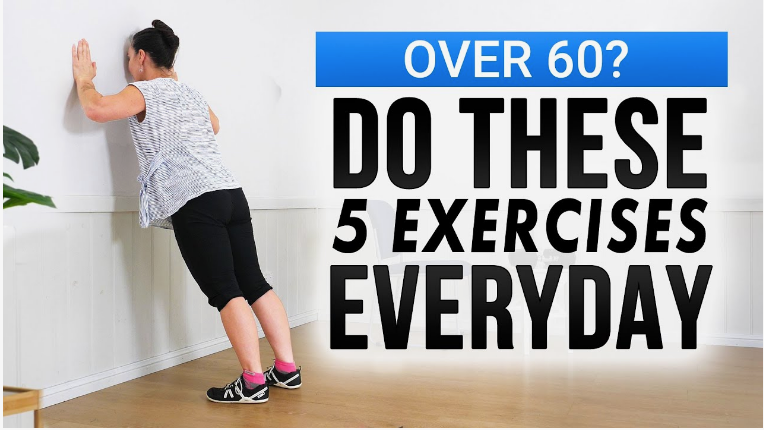
Over 60? Do THESE 3 Daily Exercises to Stay Strong & Move Pain-Free
Over 60? Do THESE 3 Daily Exercises to Stay Strong: If you’re over 60 and keep hearing terms like “eccentric loading,” “functional mobility,” and “neuromuscular coordination,” don’t be intimidated. These are just scientific names for something simple: training your body to move safely and confidently every day.
Many people assume that joint pain, stiffness, and weakness are inevitable parts of aging. That is not true. Research consistently shows that targeted daily movement can restore strength, reduce pain, and protect your independence — regardless of your current fitness level.
In 2026, seniors have more access to evidence-based home exercise guidance than ever before, and the three exercises in this article require zero equipment, zero gym membership, and less than 10 minutes per day.
This article covers:
- Why your body sends warning signals after 60 and what they mean
- The 3 most effective daily exercises for seniors (with beginner and advanced versions)
- Exact sets, reps, and progressions for each exercise
- A step-by-step 30-day plan to build the habit
- Common form mistakes that cause injury — and how to avoid them
- What results to realistically expect at 4, 8, and 12 weeks
No gym, equipment, or prior fitness experience required.
What Does “Functional Strength” Really Mean for Seniors? (Very Important)
It does NOT mean lifting heavy weights or following an athlete’s training program. It does NOT mean eliminating all pain overnight. And it does NOT mean exercising until you’re exhausted.
It means:
- Strength that transfers directly to daily life — standing up from a chair, lifting groceries, climbing stairs without gripping the railing
- Muscle control through a full range of motion — not just being strong, but being strong at the right moments
- Stability under unpredictable conditions — catching yourself on uneven ground, reacting quickly to a slip
So when fitness professionals say “build functional strength,” they mean:
- Train the movements you use every single day — because those are the ones that protect your independence.
- Focus on quality of movement, not quantity of exercise. Ten slow, controlled reps build more usable strength than 30 rushed ones.
Real-world example: A 68-year-old woman who trained the sit-to-stand three times per week for 8 weeks improved her ability to rise from a chair without using her hands — a direct marker of independence and fall prevention in clinical research.
Why Senior Exercise Science Has Advanced So Much in 2026
Three developments make this topic more important than ever:
- Muscle loss is measurable and reversible. Adults over 60 lose approximately 3% of muscle mass per year without resistance training — a condition called sarcopenia. The good news: even low-load bodyweight exercises significantly slow and partially reverse this process.
- Fall risk is the leading preventable health threat for seniors. According to the CDC, falls are the leading cause of fatal and nonfatal injuries for adults over 65, and strength and balance training are the most effective proven interventions.
- Short daily sessions outperform occasional long workouts. Research in the Journal of Aging and Physical Activity confirms that consistency matters more than duration — making 10-minute daily sessions a legitimate, science-backed approach.
Because of this, the CDC, the National Institute on Aging, and the American College of Sports Medicine all officially recommend multicomponent exercise programs for older adults that include strength, balance, and cardiovascular training.
This is 100% legitimate and backed by decades of peer-reviewed research and national health authority guidelines.
Average Results You Can Realistically Expect
| Timeframe | What Most Seniors Notice |
|---|---|
| Weeks 1–2 | Reduced morning stiffness; easier time standing up |
| Weeks 3–4 | Noticeably less effort getting in and out of chairs; improved posture |
| Weeks 5–8 | Measurable strength gains; greater walking confidence and balance |
| Months 3–6 | Sustained independence; reduced joint pain with daily tasks |
A landmark study in the Journal of Strength and Conditioning Research found that older adults who practiced sit-to-stand exercises for just 8 weeks showed a 30% improvement in lower body strength and reported significantly more confidence in daily movements.
Reality check: These exercises are not a cure for arthritis, osteoporosis, or chronic injury. They reduce pain and build strength gradually. You won’t feel dramatically different in 3 days. Most people notice meaningful changes at the 4-week mark when consistency is maintained. Some exercises may feel awkward at first — that’s normal. Discomfort from muscle effort is fine. Sharp or joint pain is a signal to stop and consult your doctor.
3 High-Value Daily Exercises for Seniors Over 60
Exercise 1: Sit-to-Stand (The Independence Benchmark)
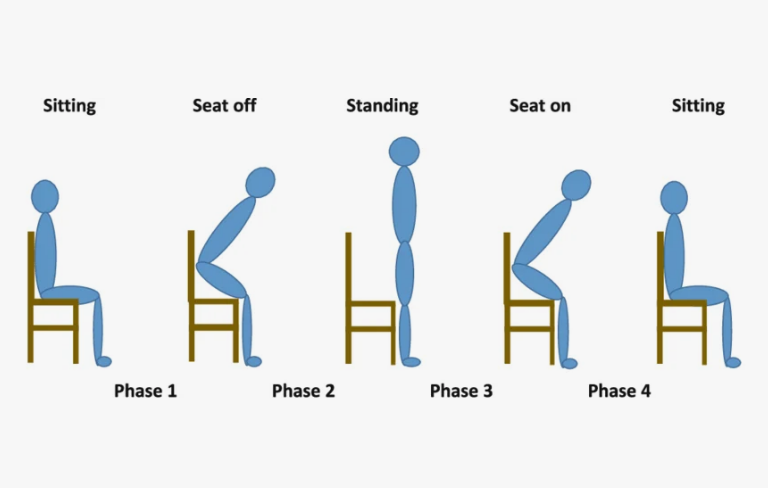
You do NOT need any equipment — a sturdy chair is everything you need.
The sit-to-stand is the single most important movement for seniors. Every time you rise from a chair, couch, car seat, or park bench, your body uses the same muscles: quadriceps, glutes, and core. When these muscles weaken, most people unconsciously switch to momentum — rocking forward and thrusting up — which strains the knees and lower back. Strength training this movement eliminates that pattern entirely.
How to do it correctly:
- Sit near the front edge of a sturdy, non-wheeled chair
- Feet flat on the floor, hip-width apart, toes slightly behind your knees
- Take a breath in through your nose
- Lean your chest slightly forward (back stays straight, not rounded)
- Exhale and press through your heels to stand — think “push the floor away”
- Stand fully upright, gently squeeze your glutes, pause 1 second
- Inhale and slowly lower back down with control — don’t drop into the chair
- The lowering phase (eccentric) is where most strength gains occur
Modifications:
- Easier: Place a folded towel on the seat to raise the height; use fingertips lightly on armrests
- Harder: Cross arms over chest (removes hand support entirely); pause halfway down for 3 seconds before sitting
Performance metrics:
- Targets: Quadriceps, glutes, hamstrings, hip flexors, core
- Starting prescription: 3 sets of 8–10 reps, 3 days per week
- Progression target: 12–15 reps without hand assistance by Week 6
- Rest between sets: 60–90 seconds
Cost/time investment: Zero equipment; approximately 5 minutes total.
Good for beginners: Yes — height modification makes it immediately accessible at any level.
Common form errors:
- Rising too fast using momentum instead of muscle strength
- Knees caving inward (track knees over second toe)
- Rounding the back instead of hinging forward at the hips
- Holding breath during the effort — always breathe
Exercise 2: Wall Push-Up (The Posture and Shoulder Defender)
You do NOT need a mat, bench, or gym — any wall in your home works.
As we age, upper body strength declines and posture suffers. Rounded shoulders pull the spine forward, compress the chest, and contribute to neck and back pain. The wall push-up directly targets the chest, shoulders, triceps, and core, building the strength needed for reaching overhead, carrying items, pushing a shopping cart, and getting up from the floor.
Research published in the Journal of Physical Therapy Science confirms that push-up variations significantly improve posture, reduce shoulder discomfort, and boost functional ability in older adults — with less pain during daily activities as a measurable outcome.
How to do it correctly:
- Stand facing a wall, arm’s length away
- Place hands flat on the wall at shoulder height, slightly wider than shoulders
- Step feet back 6–12 inches — your body forms a straight line from head to heels
- Engage your core (gentle tension, like bracing for a nudge)
- Inhale as you slowly bend elbows at a 45° angle, bringing chest toward wall
- Lower until your nose is a few inches from the wall or as far as comfortable
- Pause briefly, then exhale and push through your palms to return
- Move as one solid unit — no sagging hips or arching back
Modifications:
- Easier: Stand closer to the wall (reduces load significantly)
- Harder: Step feet farther back; progress to a kitchen counter, then a sturdy table
- Advanced: Floor push-ups from knees when ready
Performance metrics:
- Targets: Chest, shoulders, triceps, core, upper back
- Starting prescription: 3 sets of 8–10 reps, 3 days per week
- Tempo: 2 seconds down, brief pause, 2 seconds up
- Progress marker: Feet at 18–24 inches from wall with full control by Week 6
Cost/time investment: Zero; under 5 minutes per session.
Good for beginners: Yes — standing close to the wall makes it immediately gentle and safe.
Pro tip: Use idle moments — waiting for water to boil, during TV commercials. The portability of this exercise makes daily consistency easy.
Common form errors:
- Moving too fast (reduces effectiveness, increases joint stress)
- Hips sagging toward the wall (stresses lower back)
- Hands placed too high or too low (strains shoulder joint)
- Holding breath — exhale on the push, always
Exercise 3: Standing March with Arm Swings (The Balance and Cardio Combination)
You do NOT need any space beyond a small patch of floor — do this right where you stand.
This exercise is the most underrated movement for seniors. In one simple activity, it trains cardiovascular endurance, balance, coordination, hip flexor strength, and posture simultaneously. Think of it as four exercises in one.
The cardiovascular dimension matters because the heart becomes less efficient with age, blood vessels lose some elasticity, and stamina decreases. The American Heart Association confirms that even moderate aerobic activity, performed consistently, lowers heart disease risk, improves circulation, boosts energy, and supports brain health.
The balance dimension matters equally. Research in the Journal of Aging and Physical Activity confirms that exercises combining coordinated movement patterns — like marching — significantly improve balance and reduce fall risk in older adults. Lifting one leg at a time while controlling arm movements trains the exact balance system needed for stairs, uneven ground, and daily walking.
How to do it correctly:
- Stand tall, feet hip-width apart; position near a wall or chair for optional light support
- Engage core gently; roll shoulders back into upright posture
- Lift your right knee toward your chest (comfortable height — hip to waist level)
- Simultaneously swing your left arm forward and right arm back (opposite arm and leg)
- Lower right foot with control; repeat on left side
- Continue alternating in a smooth, rhythmic march
- Focus on lifting through the knee, not shuffling the feet
- Breathe naturally — try 2 steps inhale, 2 steps exhale for rhythm
Modifications:
- Easier: March without arm swings first; hold chair lightly with one hand
- Harder: Lift knees higher; increase pace slightly; add 1-lb hand weights
Performance metrics:
- Targets: Hip flexors, glutes, shoulders, cardiovascular system, balance system
- Starting prescription: 3 rounds of 1–2 minutes, 30-second rest between rounds
- Progression target: 3–5 minutes per round by Week 6
- Daily frequency: Every day as a warm-up or standalone session (low impact)
Cost/time investment: Zero; as little as 3–5 minutes per day.
Good for beginners: Yes, immediately — even slow, supported marching delivers balance and circulation benefits.
Common form errors:
- Marching too fast and losing control of the movement
- Slouching forward instead of maintaining upright posture
- Holding breath
- Stepping down too hard — land softly with control
3-Exercise Daily Comparison Table
| Exercise | Primary Muscles | Daily Time | Equipment | Best For |
|---|---|---|---|---|
| Sit-to-Stand | Quads, glutes, core | ~5 min | Chair | Lower body strength + independence |
| Wall Push-Up | Chest, shoulders, triceps, core | ~4 min | Wall | Upper body strength + posture |
| Standing March | Hip flexors, cardio, balance | ~5 min | Optional chair | Balance + cardiovascular health |
How Seniors Actually Build This Habit (Step-by-Step)
Step 1: Set Up Your Safe Exercise Space
Choose one consistent spot in your home — living room, kitchen, or bedroom. Position a sturdy, non-wheeled chair within arm’s reach. Clear a 4×4 foot floor area. Keep water nearby. Wear supportive, non-slip shoes or exercise barefoot on a non-slip mat.
Avoid: Exercising on slippery socks, rolling chairs, or near unstable furniture.
Tools needed: One sturdy chair, non-slip surface, water bottle.
Step 2: Start with Week 1 Minimums — Not Maximums
For the first week, do one set of each exercise only. This prevents soreness that discourages continuation.
- Sit-to-Stand: 1 set × 8 reps
- Wall Push-Up: 1 set × 8 reps (close to wall)
- Standing March: 1 round × 1 minute
Perform this sequence Monday, Wednesday, and Friday.
Avoid: Jumping to 3 sets in Week 1. Soreness from overdoing it is the most common reason seniors quit in the first two weeks.
Tools needed: Phone timer or clock; chair near the wall.
Step 3: Add Sets and Reps Progressively
Beginning in Week 2, add one set per exercise. By Week 4, you should be at the full 3-set prescription for each movement.
Use this simple progression rule: when 3 sets of 10 reps feel comfortable for two consecutive sessions, make one modification harder. For sit-to-stand, that means removing hand support. For wall push-ups, step feet back 4 more inches. For marching, add one extra minute.
Avoid: Increasing difficulty on two exercises in the same week. Change one at a time.
Tools needed: A simple notebook or phone app to log reps and sessions.
Step 4: Use the 5-Minute Morning Protocol Daily
Every morning — even on rest days — do 1 minute of standing marching only. This keeps the body warm, maintains the habit, and provides daily cardiovascular and balance input without overtraining.
The 1-minute march wakes up the hip flexors, improves circulation, and sets a positive physical tone before your day starts.
Avoid: Skipping this entirely on off days. The 1-minute daily minimum is more valuable than you think for neurological balance adaptation.
Tools needed: A phone alarm labeled “1-minute morning march.”
Step 5: Track and Check In at 30 Days
After 30 days, conduct a simple self-assessment:
- Can you complete 3 sets of 10 sit-to-stands without hand assistance?
- Can you complete 3 sets of 10 wall push-ups with feet 18 inches from the wall?
- Can you march continuously for 3 minutes without stopping?
If yes to any of these, you’ve progressed. Document it. Share it with your doctor at your next appointment.
Avoid: Comparing your progress to others. These benchmarks are personal, and any improvement is meaningful.
Tools needed: Your exercise log from Step 3.
Recommended Programs and Platforms for Seniors
| Resource | Description | Cost | Best For |
|---|---|---|---|
| Go4Life (NIA) | National Institute on Aging’s free exercise guide with videos for all levels | Free | Beginners wanting government-backed routines |
| SilverSneakers | Medicare-covered fitness program with in-person and virtual class options | Free with qualifying Medicare plans | Seniors wanting community + coaching |
| ACSM-Certified Personal Trainers | Find a certified trainer specializing in senior fitness via ACSM’s directory | $40–$100/session | Seniors with medical conditions needing supervision |
| YouTube Senior Fitness Channels | Free follow-along video programs (search “senior fitness” + “beginner”) | Free | Home exercisers wanting guided sessions |
Can a Senior With Joint Pain or Limited Mobility Succeed?
Yes. Absolutely.
Three reasons:
- Every exercise has multiple modifications. The sit-to-stand works on a raised surface. The wall push-up works with your hands 6 inches from the wall. The march works with one hand on a chair. There is a version of each exercise for every starting level.
- Low-load training is proven effective for joint pain. A 2022 meta-analysis confirmed that low-intensity bodyweight exercises reduce knee and hip pain in older adults with osteoarthritis — not worsen it. Movement, not rest, is the therapeutic approach.
- You do NOT need to be pain-free to start. Mild discomfort from stiff muscles is expected and resolves within 1–2 weeks. You’re building the capacity to move more comfortably, not trying to feel perfect before you begin.
Can you also improve mood and brain health? Yes. The American Heart Association and research on exercise and cognitive aging confirm that regular physical activity improves mood, reduces anxiety, and supports brain health in older adults — including better memory and processing speed.
Realistic success example: A 72-year-old man with moderate knee pain began the sit-to-stand with a raised seat cushion and arm support. By Week 8, he completed 12 unassisted reps per set and reported that climbing stairs no longer caused his usual knee pain. His GP noted improved functional scores at his next checkup.
Top 2 barriers addressed:
- Time: All three exercises together take under 10 minutes. Even 5 minutes — the march alone — delivers balance and cardiovascular benefit.
- Health concerns: These are exactly the conditions these exercises are designed for. Always inform your doctor you’re starting, but these are among the safest, most medically recommended movements for seniors.
Important Warnings (Read This Carefully)
Watch out for these red flags in senior fitness content and programs:
- ❌ Programs claiming to “cure” arthritis or “reverse” joint damage — exercise manages symptoms and builds strength; it does not reverse structural damage
- ❌ “No pain, no gain” messaging — sharp, shooting, or joint pain during exercise means stop, not push through
- ❌ Programs that skip progressions and start seniors at full intensity — this is the fastest path to injury and dropout
- ❌ Supplement upsells attached to exercise programs — legitimate senior fitness guidance does not require supplements to work
- ❌ High-intensity jumping or impact exercises marketed to seniors — plyometrics are not appropriate as a starting point for adults over 60 without clinical clearance
If someone promises “you’ll eliminate all pain in 7 days” with exercises alone, it is a scam.
How to verify a program’s legitimacy:
- Check for alignment with NIA, CDC, or ACSM guidelines for older adult exercise
- Confirm the instructor holds credentials from ACE, ACSM, NASM, or NSCA with a senior specialty
- Look for programs that include modifications and progressions, not a one-size-fits-all approach
The Science Behind Why These 3 Exercises Work
These three exercises were not chosen randomly. They target the four physical systems that the NIA and CDC identify as most critical for senior health and fall prevention: strength, balance, flexibility, and endurance.
Research from the Journal of Strength and Conditioning Research confirms that 8 weeks of sit-to-stand training produces a 30% increase in lower body strength and measurable reduction in knee pain in adults over 60.
Research published in the Journal of Physical Therapy Science demonstrates that push-up variations significantly improve posture, reduce shoulder discomfort, and restore functional upper body capacity in older adults.
Research in the Journal of Aging and Physical Activity confirms that combined movement exercises like marching reduce fall risk and improve coordination — critical because falls are the leading cause of injury-related hospitalizations in adults over 65.
Key principles:
- Progressive overload at low intensity — small, consistent increases in demand are safer and equally effective for seniors as heavier loads
- Eccentric control (the lowering phase of each exercise) is where most strength gains occur — slow it down
- Frequency beats intensity — 3–5 short sessions per week outperform 1–2 long ones for senior adaptation
- Multicomponent training (strength + balance + cardio in one session) is what the CDC specifically recommends for fall prevention in older adults
5 Common Mistakes Seniors Make With These Exercises
- Using momentum instead of muscle. Why it’s a problem: rocking to stand or bouncing off the wall eliminates the strength-building stimulus. Do instead: pause for 1 second at the bottom of each movement before beginning the push.
- Skipping the lowering phase. Why it’s a problem: dropping into the chair or “falling” back to the wall wastes the most productive part of the exercise. Do instead: take 2–3 full seconds to lower yourself under control, every rep.
- Holding breath during effort. Why it’s a problem: breath-holding spikes blood pressure and reduces core stability. Do instead: exhale during the effort phase (standing up, pushing away), inhale on the way down.
- Jumping to advanced versions too quickly. Why it’s a problem: skipping progressions increases injury risk and discourages continuation. Do instead: earn each progression — spend at least two weeks at each level before advancing.
- Exercising only when “feeling good.” Why it’s a problem: consistency, not intensity, drives adaptation. Do instead: commit to the 1-minute morning march every day, regardless of how you feel.
Final Advice: Consistency Beats Perfection Every Time
Senior fitness is not looking for perfect form from day one. It’s looking for:
- Showing up — 3 sessions per week, every week, with whatever modifications you need
- Patience — meaningful strength and balance improvements take 4–8 weeks to feel and 12 weeks to fully establish
- Self-awareness — knowing the difference between productive muscle fatigue and pain that signals a problem
Many successful seniors started with:
- Just the sit-to-stand — 5 reps once a day, nothing else, for two weeks
- A single minute of marching in place every morning before coffee
Your 3-step action plan:
- Today: Do one set of 8 sit-to-stands from your couch right now
- This week: Complete all three exercises on Monday, Wednesday, and Friday
- By 90 days: Perform 3 full sets of each exercise with one modification level harder than your starting point
Conclusion
Staying strong and moving pain-free after 60 in 2026 is real, achievable, and accessible — even for seniors with joint pain, limited mobility, or zero prior exercise experience.
These three daily exercises — the sit-to-stand, wall push-up, and standing march with arm swings — deliver three non-negotiable benefits:
- Lower body strength that protects your independence and reduces fall risk
- Upper body and postural strength that makes daily tasks easier and reduces chronic pain
- Cardiovascular and balance training that supports your heart, brain, and coordination
If you take time to follow the progressions, maintain weekly consistency, and avoid the urge to skip the modifications, this simple routine can change your mobility, confidence, and independence permanently.
Start today: Set a chair in front of your wall, set a 10-minute timer, and complete one set of each exercise. That’s all it takes to begin.
Frequently Asked Questions
Q: How many days per week should I do these exercises? Short answer: 3–5 days per week. The NIA recommends strength and balance activities at least 2–3 days per week, with light activity like marching every day being safe and beneficial.
Q: Is it okay to do all three exercises on the same day? Short answer: Yes. The full sequence takes under 10 minutes and is designed as one routine.
Q: What if I feel sore after the first session? Short answer: Mild muscle soreness 24–48 hours after is normal and means your muscles are adapting. Sharp joint pain during exercise means stop immediately and consult your doctor.
Q: Can I do these exercises if I have knee or hip arthritis? Short answer: Generally yes, with modifications. Low-intensity bodyweight exercise is proven to reduce arthritis-related pain over time. Always use the modified versions (raised chair, close wall position) and consult your doctor first.
Q: How long until I notice a real difference? Short answer: Most seniors notice improved ease with daily movements at the 4-week mark. Measurable strength changes typically appear at 6–8 weeks of consistent training.
Q: Do I need to warm up before these exercises? Short answer: Yes. Start with 1–2 minutes of slow marching in place to warm up joints and increase circulation before beginning sit-to-stands or wall push-ups.
Q: Can I progress beyond these three exercises? Short answer: Absolutely. Once all three are comfortable at their harder versions, add lunges, heel raises, and resistance band exercises to continue building strength.
Q: Do I need to see a doctor before starting? Short answer: It’s strongly recommended. Inform your physician that you’re beginning a low-intensity bodyweight program — especially if you have cardiovascular conditions, recent surgery, or uncontrolled hypertension.
Resources
Free Resources:
- NIA Go4Life (nia.nih.gov/go4life) — Free exercise videos and printable guides for adults 60+
- CDC Fall Prevention Resources (cdc.gov/falls) — Evidence-based balance and strength programs
- ACSM Exercise Guidelines for Older Adults — Downloadable PDF outlining official frequency and intensity targets
Recommended Books:
- Younger Next Year by Chris Crowley and Henry Lodge, MD — science-based case for daily movement after 60
- Strength Training Past 50 by Wayne Westcott and Thomas Baechle — detailed progression guide for older adults
Communities:
- SilverSneakers online community — free class access, forums, and peer support for Medicare-eligible adults
- Local senior center exercise classes — free or low-cost group programs with in-person instructor guidance
Legal Disclaimer
This article is for informational purposes only and does not constitute medical advice. Consult your physician or a licensed healthcare provider before beginning any new exercise program, particularly if you have cardiovascular disease, osteoporosis, recent joint replacement, uncontrolled hypertension, or balance disorders. Individual results vary. Stop any exercise that causes sharp, shooting, or joint pain and seek medical advice. These exercises are general recommendations and are not a substitute for personalized professional guidance.