
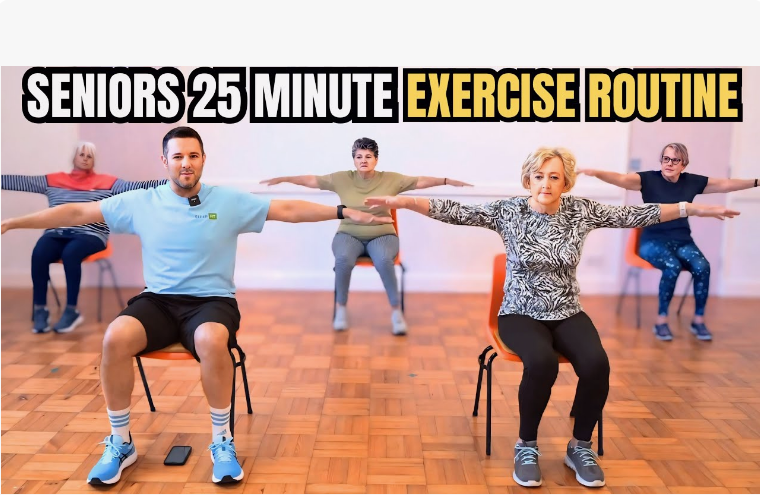
The Best 25-Minute Exercise Routine for Seniors Over 60 – Full Body Workout (No Equipment Needed)
Best 25-Minute Exercise Routine for Seniors Over 60: If you’re new to exercising over 60 and keep hearing terms like “functional fitness,” “multicomponent training,” and “low-impact strength work,” you’re not alone. These phrases sound complicated, but they describe simple movements you can do right in your living room.
Many people assume a full body workout is only for young, athletic people. That is not true. 12Physical activity provides benefits including reduced risk of falling, more years of independent living, and improved brain health for older adults. In 2026, science-backed chair and standing exercises make it possible for anyone over 60 to build strength, balance, and confidence in just 25 minutes a day.
Here’s what this article covers:
- What a 25-minute senior exercise routine actually looks like
- The 7 exercise categories that train your entire body
- Step-by-step instructions for all 27 movements
- How to modify exercises for your fitness level
- Common mistakes seniors make (and how to avoid them)
- Free programs and resources to get started today
No gym membership, equipment, or prior experience required.
What Does “Full Body Exercise Routine” Really Mean for Seniors? (Very Important)
It does NOT mean intense, exhausting gym workouts that leave you sore for days. It does NOT mean copying what younger athletes do on social media. And it absolutely does NOT mean pushing through pain.
It means:
- Moving every major muscle group (shoulders, arms, core, hips, legs, ankles) in one session
- Combining seated and standing exercises to match your ability level
- Including mobility, strength, and balance in one efficient workout
So when fitness professionals say “full body routine for seniors,” they mean:
- A structured sequence of exercises that warms you up gradually, works every part of your body, and finishes with a cool-down—all within a manageable time frame.
- A workout designed with rest breaks built in so you can recover between exercises without losing momentum.
Real-world example: A 67-year-old woman who hadn’t exercised in years began with seated shoulder shrugs and marching in place. Within 8 weeks, she progressed to standing squats and lunges using her kitchen chair for support. Her doctor noted improved blood pressure at her next checkup.
Why Senior Fitness Is Growing in 2026
Three industry trends are driving this growth:
- 24 The senior fitness segment (55+) is growing at a CAGR of 7.8% between 2026 and 2035, driven by aging Baby Boomer populations with 73 million Americans in their 60s and 70s.
- 27 The global virtual fitness market was valued at $34.25 billion in 2025 and is projected to grow to $43.78 billion in 2026, making home workout programs more accessible than ever.
- 2 SilverSneakers, a health and fitness program for adults age 65 and older, is covered by some Medicare plans, helping people stay mobile and active by providing access to gyms and fitness classes designed for older adults.
6 The CDC recommends that adults 65 or older include aerobic, muscle-strengthening, and balance activities each week. A 25-minute full body routine performed 5 days per week gives you approximately 125 minutes of activity—nearly hitting the 150-minute weekly target.
This is 100% safe, science-backed, and supported by the CDC, the American Council on Exercise, and the National Council on Aging.
What Results Can You Expect from a 25-Minute Routine?
Here’s a realistic breakdown of what consistent training produces:
| Experience Level | Timeline | Expected Results |
|---|---|---|
| Beginner (Weeks 1–4) | First month | Better mobility, less stiffness, improved mood |
| Intermediate (Weeks 5–12) | Months 2–3 | Noticeable leg strength, improved balance, easier daily tasks |
| Consistent (Months 4–6) | Half year | Reduced fall risk, more endurance, weight management |
| Long-term (6+ months) | Ongoing | Independent living, chronic disease management, confidence |
4 A 2025 systematic review published in the International Journal of General Medicine found that people over 60 who participated in aerobic exercise experienced lower blood pressure and heart rates, and better cardiorespiratory health. 4 Research published in JAMA Network Open in 2025 found that people who engaged in higher levels of physical activity in midlife and late life had a more than 40% lower risk of dementia.
Reality check: You won’t transform your body in a week. Consistency matters far more than intensity. Three sessions per week is a good starting point. Five is ideal. Even two is better than zero. 6Some physical activity is better than none at all.
7 Full Body Exercise Categories in the 25-Minute Senior Routine
This routine covers 27 exercises performed for 45 seconds each with 10 seconds of rest between them. They’re organized into 7 categories that work your entire body from head to toe.
Category 1: Shoulder and Upper Body Warm-Up (Seated)
You do NOT need any equipment for these exercises.
- Shoulder Shrugs – Raise shoulders toward ears, rotate them back and down
- Seated Arm Reaches – Alternate reaching each arm straight overhead
- Bicep Curls (no weights) – Clench fists, curl hands to shoulders with elbows tucked
- Side Raises – Lift arms out to shoulder level, then lower slowly
- Front Raises – Lift arms forward to shoulder level, then lower
Performance metrics:
- Targets: Shoulders, biceps, upper back, posture muscles
- Intensity: Low to moderate
- Modification: Add light dumbbells (1–3 lbs) for more resistance
- Time: Approximately 4 minutes total
Cost/time investment: Zero equipment cost; under 5 minutes per session.
Good for beginners: Yes – these seated movements are the safest starting point.
These exercises warm up the upper body while improving range of motion. Even without weights, the repetitive motion builds muscular endurance over time.
Category 2: Seated Leg Work
You do NOT need to stand for these exercises—your chair does the work.
- Seated Marching – Lift alternating knees while sitting tall
- Seated Leg Extensions – Extend each leg forward, straightening the knee
- Side Steps – Step each foot out to the side while seated, working the outer hips
Performance metrics:
- Targets: Quadriceps, hip flexors, hip abductors
- Intensity: Low
- Modification: Move forward in your chair for greater range of motion
- Time: Approximately 2.5 minutes
Good for beginners: Yes – ideal for those not yet comfortable standing.
Seated leg work builds the foundation for standing exercises. Your quadriceps and hip muscles power everything from walking to climbing stairs.
Category 3: Ankle and Lower Leg Mobility (Seated)
You do NOT need special footwear—bare feet or supportive shoes both work.
- Heel Raises (seated) – Lift heels off the floor while keeping toes down
- Toe Raises (seated) – Lift toes while keeping heels planted
Performance metrics:
- Targets: Calves, shin muscles, ankle joint mobility
- Intensity: Low
- Modification: Press down on knees with hands to increase resistance on heel raises
- Time: Approximately 1.5 minutes
Good for beginners: Yes – gentle movements with minimal injury risk.
Ankle mobility directly impacts balance. Stiff ankles are a major fall risk factor, making these exercises critical for safety.
Category 4: Core and Spine Work (Seated)
You do NOT need a yoga mat or to get on the floor.
- Side Bends – Hands on hips, lean to each side without leaning forward
- Seated Torso Twists – Cross arms over chest, rotate left and right slowly
- Neck Turns – Look over each shoulder slowly and deliberately
Performance metrics:
- Targets: Obliques, spinal rotators, neck mobility
- Intensity: Low to moderate
- Modification: Move slowly if you feel any dizziness during twists
- Time: Approximately 2.5 minutes
Good for beginners: Yes – seated core exercises are safe and effective.
Core strength stabilizes your entire body. These movements improve posture, reduce back stiffness, and make reaching or turning safer in daily life.
Category 5: Sit-to-Stand and Squat Variations
You do NOT need gym equipment—a sturdy kitchen or dining chair is all you need.
- Sit-to-Stand – Stand up from seated position, slowly sit back down
- Standing Squats – Feet hip-width apart, bend knees, push hips back
- Squat Hold with Bounces – Hold low squat position with small pulses (advanced)
Performance metrics:
- Targets: Quadriceps, glutes, hamstrings, core
- Intensity: Moderate to high
- Modification: Use chair for balance support; only lower as far as comfortable (“curtsy” range is fine)
- Time: Approximately 3 minutes
Good for beginners: Yes, with modifications – even small movements build strength.
5 Stanford researchers note that sit-to-stand exercises, in which you lower yourself up and down from a chair 10 to 15 times, gradually making it more challenging by using less hand support or a lower chair, are excellent for seniors. The squat is the single most important exercise for maintaining independence.
Category 6: Standing Balance and Leg Exercises
You do NOT need balance boards or special gear—just a chair back for support.
- Calf Raises (standing) – Rise up on tiptoes, lower slowly
- Heel Flicks – Bring heels up toward glutes behind you
- Leg Swings – Swing each leg forward and backward, holding chair
- Side Kicks – Lift leg out to the side, alternating
- Standing Knee Raises – Lift knee in front, alternating legs
- Standing Reach-Ups – Rise on tiptoes while reaching both arms overhead
Performance metrics:
- Targets: Calves, hamstrings, hip flexors, hip abductors, balance system
- Intensity: Moderate
- Modification: Keep one or both hands on chair; let go only when confident
- Time: Approximately 5 minutes
Good for beginners: Yes, with chair support – always keep the chair within arm’s reach.
15 According to the CDC, 1 in 4 Americans aged 65 and older falls each year, and falls are the leading cause of injury-related hospitalizations in this age group. These standing exercises directly improve your balance and reduce that risk.
Category 7: Cardio Marching and Full Body Finishers
You do NOT need a treadmill or any machines.
- Standing March – March in place at a comfortable pace
- March with Forward Punches – Add punching motion while marching
- March with Overhead Punches – Punch upward while marching
- Alternating Lunges – Step forward into gentle lunge, holding chair
Performance metrics:
- Targets: Heart and lungs, full body coordination, endurance
- Intensity: Moderate to high
- Modification: Slow the pace or reduce range of motion as needed
- Time: Approximately 5 minutes
Good for beginners: Yes – go at your own pace and rest when needed.
These finishers elevate your heart rate for cardiovascular benefit. The final marches include a “rest march” at a slower pace to bring your heart rate down gradually before finishing.
How Seniors Actually Complete This 25-Minute Routine (Step-by-Step)
Step 1: Set Up Your Space Safely
Place a sturdy, non-rolling chair on a flat, non-slip surface. Clear the area of rugs, cords, and clutter. Keep water within reach. Wear supportive, non-slip shoes or go barefoot on a non-slip mat.
Avoid: Rolling office chairs, slippery floors, or cramped spaces.
Tools needed: One solid chair, a water bottle, and a timer or phone.
Step 2: Start with Seated Exercises (Minutes 1–10)
Begin with shoulder shrugs, progress through seated marching, leg extensions, side steps, heel and toe raises, side bends, twists, arm reaches, bicep curls, side raises, front raises, and neck turns. Perform each for 45 seconds with 10 seconds rest between.
Avoid: Rushing through movements or holding your breath. Slow, controlled motions build more strength than fast, sloppy ones.
Key tip: Sit tall in your chair with feet flat on the floor. Don’t lean back against the backrest.
Step 3: Transition to Standing Exercises (Minutes 10–18)
Move to the back of your chair for sit-to-stands, standing calf raises, heel flicks, leg swings, side kicks, knee raises, and standing reach-ups. Hold the chair for balance on every standing exercise.
Avoid: Letting go of the chair before you’re ready. Balance improves gradually—don’t force it.
Key tip: Push through your heels on sit-to-stands and squats. Keep your chest up and eyes forward.
Step 4: Finish with Cardio Rounds (Minutes 18–25)
Alternate between marching and higher-intensity movements (punches, lunges). Include one “rest march” at a slower pace between harder rounds. End with the squat hold and pulses for a final leg burn.
Avoid: Skipping the cool-down march. Stopping suddenly after elevated heart rate can cause dizziness.
Key tip: If any movement feels too hard, simply march in place instead. Keep moving at any pace.
Step 5: Cool Down and Track Your Progress
After the final exercise, take 2–3 deep breaths. Gently stretch your shoulders, calves, and neck for 1–2 minutes. Record which exercises you completed and any modifications you used.
Avoid: Skipping the post-workout stretch. Even 60 seconds of stretching reduces next-day soreness.
Tools needed: A simple notebook or free phone app to log sessions.
Recommended Programs and Platforms for Seniors
| Program | Description | Cost | Best For |
|---|---|---|---|
| SilverSneakers | Fitness classes and gym access for Medicare-eligible adults | Free with qualifying Medicare plans | Seniors wanting community classes |
| Fit & Strong! | 8-week community program for seniors with arthritis | Free or low-cost through community centers | Beginners with joint pain |
| YouTube Channels (e.g., senior fitness creators) | Free follow-along workout videos for all levels | Free | Home exercisers on a budget |
| Go4Life (NIA) | National Institute on Aging’s free exercise program with guides | Free | Seniors wanting structured plans |
Can Someone Who Has Never Exercised Succeed at This Routine?
Yes. Absolutely.
Here’s why:
- Every exercise has a modification. Can’t stand for squats? Do a small curtsy from seated. Can’t lift both arms? Go one at a time. The routine meets you where you are.
- The 45-second intervals are forgiving. You don’t need to perform perfectly for the full 45 seconds. Even 20 seconds of effort per exercise delivers benefits.
- It’s progressive. Start seated, graduate to standing. Start with chair support, eventually let go. Your body adapts week by week.
Can you also improve your mental health? Yes. 1Exercise provides immediate benefits for older adults, including improving sleep quality, reducing anxiety, and improving blood pressure.
Realistic success example: A 72-year-old man with knee replacements started this routine doing only the seated exercises. By month three, he completed the entire standing sequence. He reported climbing stairs without holding the railing for the first time in four years.
Important Warnings (Read This Carefully)
Watch out for these red flags in senior fitness programs:
- ❌ Programs that promise “reverse aging” or “guaranteed pain elimination” – no exercise program can guarantee medical outcomes
- ❌ Trainers who push you through sharp pain – discomfort is normal, sharp pain is a stop signal
- ❌ Expensive “senior-specific” equipment marketed as essential – you need a chair, not a $500 device
- ❌ Programs that skip warm-ups and jump into intense movements – gradual progression is non-negotiable
- ❌ Anyone discouraging you from consulting your doctor first – legitimate programs always recommend medical clearance
If someone promises you’ll “look 30 years younger” or “cure arthritis” with one exercise routine, it is a scam.
How to verify legitimacy:
- Check if the program references CDC or ACSM guidelines
- Look for credentials (certified personal trainer, physical therapist, exercise physiologist)
- Read reviews from other seniors, not just testimonials on a sales page
The Science Behind Why This Routine Works
3 Moderate physical activity can improve sleep quality and lower blood pressure, while reducing your risk of dementia, heart disease, stroke, and type 2 diabetes. It also strengthens bones, improves balance, and can lower fall risk for those over 65.
Key principles that make this routine effective:
- Progressive overload: Moving from seated to standing versions of the same exercise gradually increases demand on muscles
- Multicomponent training: 9The CDC recommends older adults perform multicomponent physical activity that includes balance training, muscle strengthening, and aerobic exercise.
- Consistency over intensity: Short daily sessions produce better long-term results than occasional intense workouts
- Time under tension: The 45-second exercise intervals keep muscles working long enough to stimulate adaptation
17 Research confirms that lower-limb strength and functional performance are key determinants of fall risk, which is why this routine prioritizes squats, leg extensions, calf raises, and balance exercises.
5 Common Mistakes Beginners Make
- Skipping the seated warm-up. Cold muscles are injury-prone. Always start with shoulder shrugs and seated marching.
- Holding your breath during exertion. This raises blood pressure dangerously. Breathe out during the effort phase of each exercise.
- Going too deep into squats and lunges too soon. Small range of motion is perfectly effective. Depth comes with months of practice.
- Comparing yourself to others. Your neighbor’s flexibility is irrelevant. Focus on your own progress week to week.
- Exercising through sharp pain. Muscle fatigue is normal. Joint pain or sharp sensations mean stop, rest, and consult your doctor.
Final Advice: What the Fitness Industry Is Looking For
The fitness world is not looking for perfection from seniors. It’s looking for:
- Consistency – showing up 3–5 times per week matters more than any single workout
- Patience – real strength and balance improvements take 8–12 weeks
- Self-awareness – knowing when to push and when to rest
Many successful seniors started with:
- Just 10 minutes of seated exercises before building to 25 minutes
- Only 3 of the 27 exercises before gradually adding more
Your action plan:
- Today: Try the first 10 seated exercises with a sturdy chair
- This week: Complete the full 27-exercise routine at least twice
- By 90 days: Perform the routine 4–5 times per week with reduced chair support
Conclusion
The best 25-minute exercise routine for seniors over 60 is real, achievable, and accessible—even if you haven’t exercised in years, have joint issues, or feel nervous about starting.
In 2026, you have more resources, more research, and more support for senior fitness than ever before. This routine gives you:
- Full body strength across all major muscle groups
- Fall prevention through dedicated balance exercises
- Heart health through cardio marching intervals
If you take time to follow a structured routine, progress at your own pace, and avoid shortcuts, this workout can change your mobility, confidence, and independence permanently.
Start today: Set up a chair, queue up a follow-along video, and complete the first 10 exercises. That’s all it takes to begin.
Frequently Asked Questions
Q: Is 25 minutes of exercise enough for seniors? Short answer: Yes. 3Older adults should aim for at least 150 minutes of moderate aerobic activity each week, and it’s okay to build up slowly using 10- to 15-minute sessions. Five 25-minute sessions gets you close to that target.
Q: Do I need equipment for this routine? Short answer: No. A sturdy chair is all you need. Optional light dumbbells (1–3 lbs) can increase resistance for arm exercises.
Q: What if I can’t stand for the standing exercises? Short answer: Stay seated. Every standing exercise in this routine has a seated modification. Progress to standing when you feel ready.
Q: How many days per week should I do this? Short answer: Start with 3 days per week. Build to 5 days over several weeks. 6The CDC recommends at least 2 days of activities that strengthen muscles in addition to aerobic activity.
Q: Is this safe for people with arthritis? Short answer: Generally yes. 2Moving more can actually help lessen the pain and stiffness of arthritis. Arthritis-friendly exercise includes low-impact cardiovascular activity, strength training, and range-of-motion exercises. Consult your doctor before starting.
Q: Can I split the routine into two shorter sessions? Short answer: Absolutely. Doing 12 minutes in the morning and 13 minutes in the afternoon gives you the same total benefit.
Q: What should I eat before this workout? Short answer: A light snack 30–60 minutes before exercising. Something simple like a banana, a handful of nuts, or toast with peanut butter provides enough energy without heaviness.
Q: When will I see results? Short answer: Expect improved mood and energy within 1–2 weeks. Noticeable strength and balance improvements typically appear at 6–8 weeks with consistent effort.
Resources
Free Resources:
- Go4Life by the National Institute on Aging – Free exercise guides and videos for seniors
- CDC Physical Activity Guidelines for Older Adults – Official recommendations and sample schedules
- SilverSneakers YouTube Channel – Free follow-along workouts
Recommended Books:
- Strength Training Past 50 by Wayne Westcott and Thomas Baechle
- Exercise for Frail Elders by Elizabeth Best-Martini and Kim Jones-DiGenova
Communities:
- NCOA (National Council on Aging) – Falls prevention programs and local fitness resources
- Local senior centers – Many offer free or low-cost group exercise classes
Legal Disclaimer
This article is for informational purposes only and does not constitute medical advice. Consult your physician or healthcare provider before starting any new exercise program, especially if you have cardiovascular conditions, joint replacements, balance disorders, or other chronic health concerns. Individual results vary based on effort, consistency, health status, and pre-existing conditions. The exercises described should be performed at your own risk and within your personal comfort level.