
Understanding Team Form: A Complete Guide to Home vs Away Behavior
Learn how to analyze team form home vs away in football. Explore trends, scoring patterns, tactical insights, and venue influence on match outcomes.
In football, understanding team form is essential for anyone who wants to analyze matches intelligently. A team’s performance is rarely uniform; it often varies based on whether they are playing at home or away. By examining home and away behavior, fans, analysts, and enthusiasts can gain valuable insights into team strengths, weaknesses, and likely outcomes.
This guide will break down how to evaluate team form, explain the factors influencing home vs away performance, and provide practical methods to analyze trends.
What Is Team Form?
Team form refers to the recent performance of a football team over a series of matches. It is an indicator of:
Consistency – How often a team wins, draws, or loses
Tactical discipline – Ability to maintain structure across matches
Psychological resilience – Response to pressure and setbacks
Analyzing team form helps to understand not just results, but how and why a team performs under different conditions.
Example: In the 2023–24 Premier League season, Manchester City displayed a remarkable home form, winning 17 of 19 home games. However, their away record, while still strong, was slightly less dominant, highlighting how home advantage influences performance.
Home vs Away Performance: Key Differences
Home Form
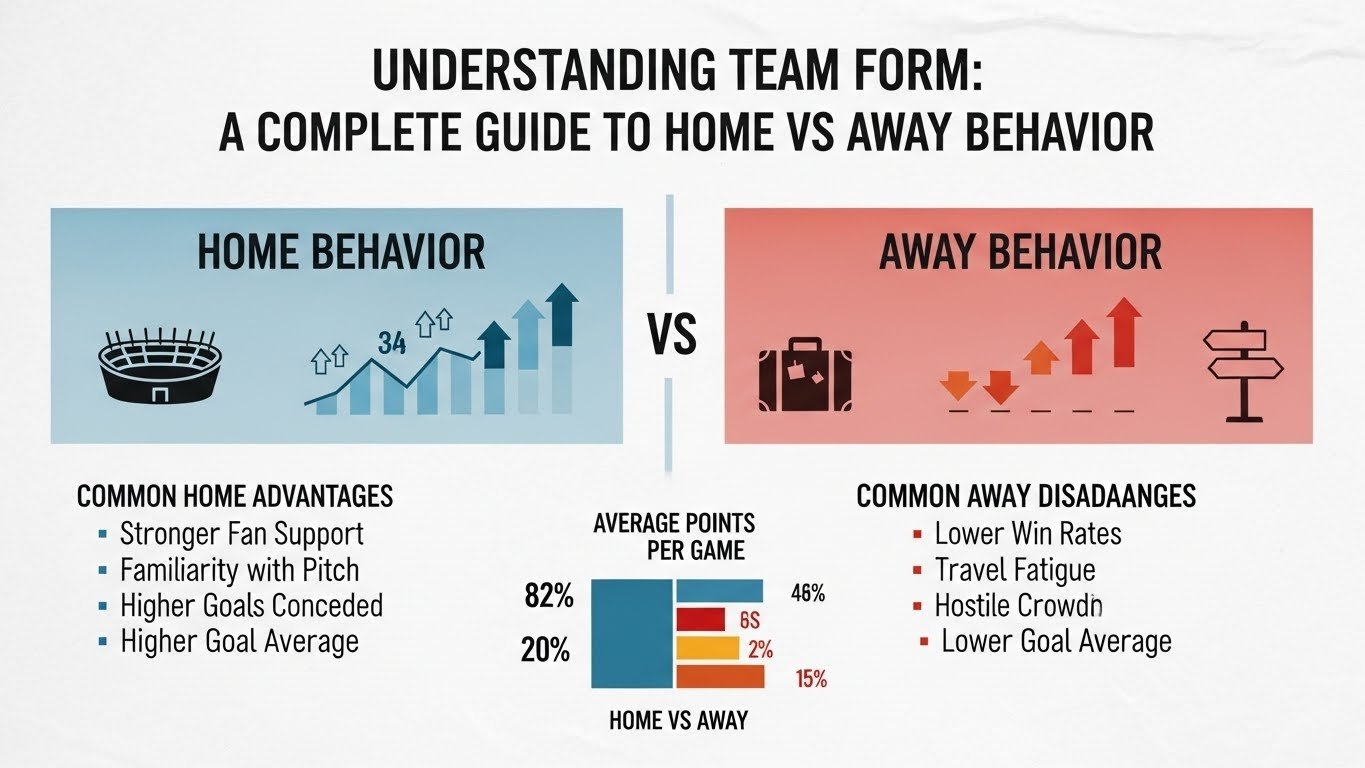
Teams generally perform better at home due to several factors:
Familiarity with the pitch – Knowing the dimensions and surface helps tactical play.
Crowd support – Fans boost morale and apply psychological pressure on opponents.
Reduced travel fatigue – Less travel means fresher players and better preparation.
Example: In La Liga 2023–24, Real Madrid won 16 out of 19 home games. Their home performance often reflected early goals and aggressive pressing, giving them a tactical edge.
Away Form
Away matches are often more challenging:
Unfamiliar conditions – Pitch, climate, and stadium atmosphere can affect performance.
Travel fatigue – Long journeys can reduce player energy and concentration.
Opponent’s home advantage – Crowd pressure can disrupt focus.
Example: Liverpool in the 2023–24 Premier League had a significantly lower win rate away from Anfield. Despite being a top team, they conceded more goals and scored fewer, reflecting common challenges in away fixtures.
Metrics to Evaluate Home and Away Form
To understand a team’s form, you should track these key metrics separately for home and away games:
Win/Draw/Loss Records
Home: High win percentage suggests strong home dominance.
Away: Low win percentage may indicate vulnerability.
Goals Scored and Conceded
Track average goals scored and goals conceded in home and away matches.
Some teams may have a strong defensive record at home but struggle defensively away.
Example: During the 2024–25 Serie A season, Napoli scored an average of 2.3 goals per home game but only 1.4 away, highlighting the influence of venue on attacking output.
Head-to-Head Records
Historical encounters against the same opponent can reveal trends.
Teams often maintain a psychological edge at home or struggle away against certain opponents.
Example: Juventus historically performs well against mid-table teams at home but struggles away against defensive teams, indicating tactical patterns influenced by venue.
Factors Influencing Home and Away Performance
Tactical Approach
Some teams play aggressively at home and defensively away.
Managers may adjust formations depending on venue to maximize points.
Player Availability
Injuries and suspensions can disproportionately affect away matches where rotation may be necessary.
Example: In 2023–24 Premier League, Chelsea conceded more goals away when key defenders were absent, showing the compounded impact of travel and missing players.
Psychological Factors
Confidence and morale are stronger at home.
Pressure from hostile crowds in away games can reduce performance.
How to Use Home vs Away Data
Analyzing home and away form can help:
Predict match trends – Identify teams likely to perform well under specific conditions.
Understand scoring patterns – Anticipate defensive or attacking tendencies.
Evaluate tactical adaptability – See how teams adjust to venue pressures.
Practical Tip: Maintain a spreadsheet tracking home vs away results, goals, and key players. Compare trends over multiple seasons for better insights.
Common Pitfalls
Relying only on recent games – Look at longer trends for accuracy.
Ignoring context – Injuries, weather, and competition type affect outcomes.
Assuming uniformity – Home advantage varies between leagues and teams.
Conclusion
Understanding team form in home vs away matches provides a deeper, data-driven perspective on football. While unpredictability is part of the game, analyzing historical performance, tactical trends, and venue impact allows fans and analysts to appreciate the strategy behind results.
By consistently monitoring home and away patterns, you can:
Assess team strengths and weaknesses
Recognize tactical adjustments
Make informed evaluations about match flow
Remember: Team form is about insight, not certainty. Historical trends empower fans to follow football smarter, enjoy matches more, and understand the beautiful game on a deeper level.